

8 Benefits of Poured Concrete Retaining Walls vs Timber
Choosing the right retaining wall material can affect more than the appearance of your yard. A retaining wall has to hold back soil, manage water, withstand changing ground conditions, and remain stable for years.
For homeowners comparing timber with poured concrete retaining walls, the decision often comes down to durability, maintenance, structural strength, appearance, and long term value.
Timber can be suitable for some smaller landscape projects, but poured concrete offers several advantages when you want a more permanent retaining wall solution. As part of our residential concrete services, we build retaining walls designed around the grade and soil conditions of your specific property. Here are eight important benefits to consider before choosing a material.
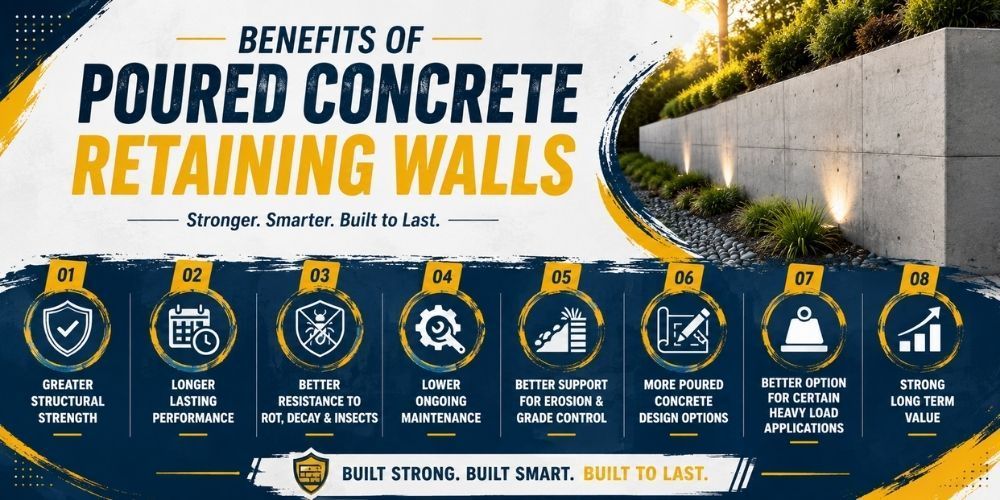
1. Greater Structural Strength
A
poured concrete retaining wall can be designed as a continuous reinforced structure rather than an assembly of individual timber boards.
Concrete is placed into forms on site and can be reinforced with steel according to the requirements of the project. The finished wall is designed to resist the pressure created by retained soil and, when applicable, additional loads above the wall.
This can make poured concrete a strong option for applications where the retaining wall needs to accommodate challenging conditions, such as:
- Significant changes in elevation
- Heavy soil pressure
- Sloped properties
- Driveways located above the wall
- Patios or pool decks near the retained soil
- Areas where drainage needs to be carefully managed
The required design depends on wall height, soil conditions, drainage, surcharge loads, and other site specific factors. A professional evaluation is important before construction.
2. Longer Lasting Performance
One of the biggest reasons homeowners consider concrete is longevity.
Timber is an organic material and can deteriorate as it is exposed to moisture, insects, soil contact, and outdoor weather conditions. Over time, boards can become weakened, damaged, or structurally compromised.
A properly designed and constructed concrete retaining wall does not rot like timber.
With appropriate reinforcement, drainage, construction, and maintenance, poured concrete can provide decades of service. That makes it attractive to homeowners who would rather install a durable wall once than repeatedly replace deteriorating materials.
The material alone, however, does not determine the lifespan of a retaining wall. Poor drainage, soil movement, inadequate design, and improper installation can create problems regardless of the wall material.
3. Better Resistance to Rot, Decay, and Wood Destroying Insects
Moisture is a major concern for timber retaining walls because the material is continually exposed to soil and, in many cases, water moving through the ground.
Over time, moisture can contribute to decay and deterioration.
Concrete does not experience biological decay in the same way.
A properly constructed poured concrete wall is not vulnerable to termite damage or wood rot, making it a practical choice for homeowners looking for a lower maintenance structural material.
This is particularly useful for retaining walls where constant contact with soil and moisture makes timber deterioration a concern.
4. Lower Ongoing Maintenance
A timber wall may require individual boards to be inspected, repaired, or replaced as they age.
Poured concrete generally requires less routine maintenance after installation. That does not mean a concrete retaining wall should simply be ignored.
Homeowners should periodically look for:
- New or widening cracks
- Leaning or movement
- Soil displacement
- Erosion near the base
- Water pooling behind the wall
- Drainage problems
- Changes following heavy rainfall
Identifying these issues early can help prevent a minor drainage or structural problem from becoming a major repair.
Compared with replacing deteriorated timber boards, maintaining a properly constructed concrete wall can be relatively straightforward.
5. Better Support for Erosion and Grade Control
Retaining walls are commonly used to manage changes in elevation and stabilize soil.
On a sloped property, rainwater can move soil downhill and gradually alter the grade. A properly designed retaining wall can help hold the desired elevation while creating more usable space for landscaping or outdoor living.
However, the wall should be viewed as part of a larger drainage and grading system.
Drainage Is Critical
Water that accumulates behind a retaining wall can increase pressure against the structure. Proper design may include suitable backfill, drainage aggregate, perforated drainage pipe, outlets, and other drainage measures depending on the site.
This is particularly important in San Antonio, where periods of heavy rainfall can quickly increase runoff and soil moisture.
A strong wall with inadequate drainage can still develop problems. Good retaining wall construction therefore involves managing both soil pressure and water pressure.
6. More Poured Concrete Retaining Wall Design Options
A retaining wall does not have to look like a purely functional structure.
One advantage of poured concrete is the ability to customize the finished appearance. Depending on the project, homeowners may choose from options such as:
- Smooth concrete finishes
- Integral color
- Decorative textures
- Stamped patterns
- Stucco style finishes
- Decorative wall caps
Poured Concrete Retaining Wall Design Ideas
A smooth finish can complement a modern home and create a clean architectural appearance.
A textured or stucco style finish may work better with traditional landscaping.
Decorative stamping can also create the appearance of stone or other materials while maintaining the structural characteristics of a poured concrete wall.
The best design depends on the home's architecture, landscaping, desired maintenance level, and budget.
7. Better Option for Certain Heavy Load Applications
Not every retaining wall carries the same amount of load.
A small garden wall may only retain a limited amount of soil. A wall supporting a driveway, patio, pool deck, or other feature may need to account for additional loads above the retained soil.
In these situations, the retaining wall needs to be designed around the actual site conditions.
Reinforced poured concrete can be a suitable option for many structural retaining wall applications because the wall can be designed specifically for the required loads and soil conditions.
However, poured concrete should not automatically be considered the right answer for every project. Wall height, soil type, drainage, surcharge, access, and local requirements all need to be considered.
8. Strong Long Term Value
Timber can have a lower initial cost for some retaining wall applications. That can make it attractive when the primary consideration is the upfront installation price.
But homeowners should look beyond the initial quote.
The total value of a retaining wall can also depend on:
- Expected service life
- Maintenance
- Repair requirements
- Replacement frequency
- Drainage requirements
- Structural requirements
- Finished appearance
A material that costs less initially may not remain the less expensive option if it requires more frequent repairs or replacement.
For homeowners looking for a long term solution, the durability and lower maintenance requirements of properly constructed poured concrete can make it a worthwhile investment.
Poured Concrete vs. Timber Retaining Walls
The differences are easier to understand when the two materials are compared directly.
| Factor | Poured Concrete | Timber |
|---|---|---|
| Structural performance | Can be engineered and reinforced for site requirements | Depends on timber, construction, height, and site conditions |
| Rot | Does not rot like wood | Vulnerable to decay |
| Wood destroying insects | Not susceptible to termite damage | Can be vulnerable to insects |
| Maintenance | Generally low after proper installation | Individual boards may require maintenance or replacement |
| Design | Multiple finishes, colors, and textures | Primarily natural wood appearance |
| Upfront cost | Often higher | Often lower for certain applications |
| Longevity | Can provide decades of service when properly designed | Generally more vulnerable to deterioration |
| Heavy load applications | Can be designed for substantial site specific loads | Application depends heavily on design and material |
| Replacement | Typically less frequent when properly constructed | May eventually require replacement as wood deteriorates |
The best choice depends on the property. For homeowners prioritizing longevity, structural performance, and lower maintenance, poured concrete can be a strong alternative to timber.
When Should You Replace a Timber Retaining Wall?
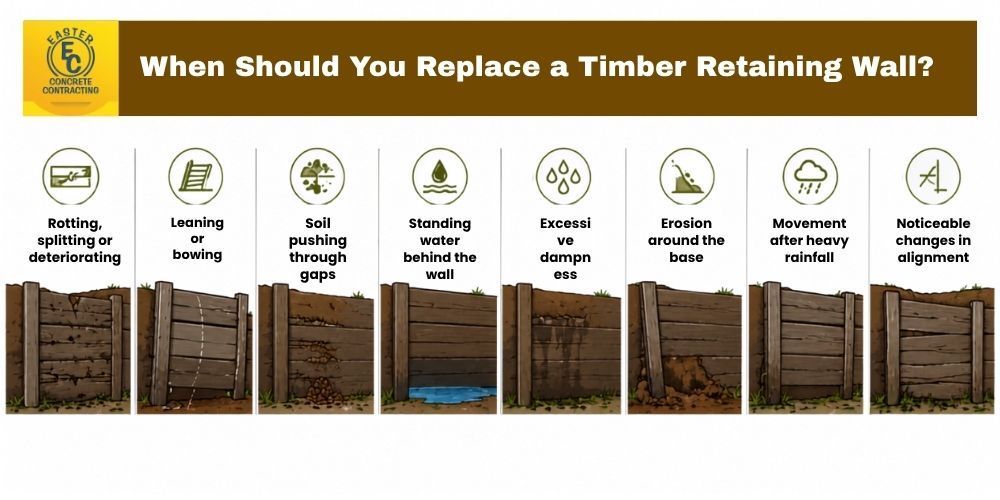
An aging timber wall does not necessarily fail without warning.
Look for signs such as:
- Boards that are rotting, splitting, or deteriorating
- Leaning or bowing
- Soil pushing through gaps
- Standing water behind the wall
- Excessive dampness
- Erosion around the base
- Movement after heavy rainfall
- Noticeable changes in the wall's alignment
These symptoms can indicate that the problem is more than cosmetic.
A leaning wall, for example, may indicate excessive soil or water pressure. Replacing or rebuilding the wall may be more appropriate than simply replacing a few visible boards.
If you're considering replacing an older timber wall with poured concrete, the site should be evaluated before deciding on the new wall design.
How Much Does a Poured Concrete Retaining Wall Cost?
There is no single price that accurately applies to every poured concrete retaining wall project in San Antonio.
Several factors can affect the final cost, including:
- Wall height
- Wall length
- Soil conditions
- Excavation requirements
- Reinforcement
- Drainage requirements
- Site accessibility
- Concrete volume
- Existing wall removal
- Decorative finishes
A wall supporting a driveway or other structure may have substantially different requirements from a small landscape wall.
That is why a site specific estimate is more useful than relying on a generic price per foot figure.
What Makes a Concrete Retaining Wall Strong?
The strength of a retaining wall depends on more than the concrete itself.
A properly designed system may need to account for:
Foundation and footing: The base must be appropriate for the wall and site conditions. The same principles that determine whether a slab needs a poured or block foundation apply here too. Our guide on poured concrete versus block concrete foundations covers that comparison in more detail.
Reinforcement: Steel reinforcement may be incorporated where required by the structural design.
Drainage: Water must be managed so it does not create excessive pressure behind the wall.
Backfill: Appropriate backfill material and placement can affect drainage and soil pressure.
Soil conditions: Soil type and movement influence the loads acting on the wall.
Surcharge loads: Driveways, patios, structures, and other loads near the top of the wall may need to be considered.
This is why retaining wall construction should be approached as a complete structural and drainage system rather than simply pouring concrete into a trench.
Is Poured Concrete Better Than Timber for Every Retaining Wall?
Not necessarily.
Different properties require different solutions.
Timber may make sense for certain smaller landscaping applications where budget, appearance, and project requirements make it appropriate.
Poured concrete may be a better fit when the homeowner prioritizes durability, low maintenance, structural performance, and a longer term solution.
The right material should be selected after considering the site's:
- Wall height
- Soil conditions
- Drainage
- Grade
- Loads above the wall
- Access
- Desired appearance
- Local construction requirements
A professional site assessment can help determine which system makes sense for the property.
Build or Replace a Retaining Wall in San Antonio
If your timber retaining wall is aging, leaning, or showing signs of deterioration, replacing it before a major failure can help protect your landscape and surrounding property.
At Easter Concrete Contracting, we evaluate the wall, grade, soil conditions, drainage, access, and intended use before determining the appropriate concrete solution.
Whether you are replacing an old timber retaining wall, stabilizing an eroding slope, or creating usable space on a sloped property, a properly designed poured concrete retaining wall can provide a durable and attractive long term solution.